
Components
- 3 tea cups of wheat flour, approximately 400 grams
- 4 tea cups of spinach leaves (half a pack)
- Four eggs
- One teaspoon of salt
- 1/2 cup of water (tea)
- flour the countertop with wheat flour
Setup phase
- Remove the spinach leaves from the stems and rinse them under running water. Place them in a medium-sized pan, add water, cover, and cook over low heat for about 8 minutes until the leaves become very tender. Be careful not to overcook the spinach; it should remain soft while retaining its green color.
- Place the spinach in a sieve and press it firmly with a spoon to extract the water. While it is still warm, separate the other ingredients to prevent the heat from the spinach from cooking the eggs.
- Once the spinach is heated, firmly squeeze the leaves with your hands to remove all the liquid, then place them in the blender – it is crucial to thoroughly press the leaves to prevent the water from affecting the dough’s consistency.
- In a small bowl, crack one egg at a time and add the spinach—this way, if one egg is bad, the recipe isn’t ruined. Beat for 2 minutes until the spinach is finely shredded.
- In a big bowl, combine the flour and salt, create a well in the middle, and add the eggs mixed with the spinach. Using a fork, gradually blend the liquid into the flour by stirring in circular motions from the center outward.
- Continue kneading with your hands until a ball is formed. Place it on a lightly floured surface and knead until the dough is smooth and soft, about 10 minutes – since the spinach dough is moister, avoid adding too much flour to prevent it from becoming dry and tough. Shape into a ball, wrap in plastic wrap, and let it rest at room temperature for 30 minutes before rolling out.
- After resting, dust the bench with flour, separate the dough, and use a spatula or knife to divide it into 6 portions to make it easier to roll out. Cover the dough pieces with a cloth to prevent them from drying while you work.
- Roll out the dough until it reaches approximately 1 mm in thickness. Tip: For stuffed pasta, roll the dough a bit thinner.
To roll out the dough with a noodle rolling pin
Lightly press the dough into a rectangular shape to make it easier to open and cut into the desired form. Dust the work surface, dough, and rolling pin with flour. Roll out the dough to approximately 1 mm thickness, sprinkling flour continuously, then cut it into the preferred shapes.
To roll out the dough with a pasta roller.
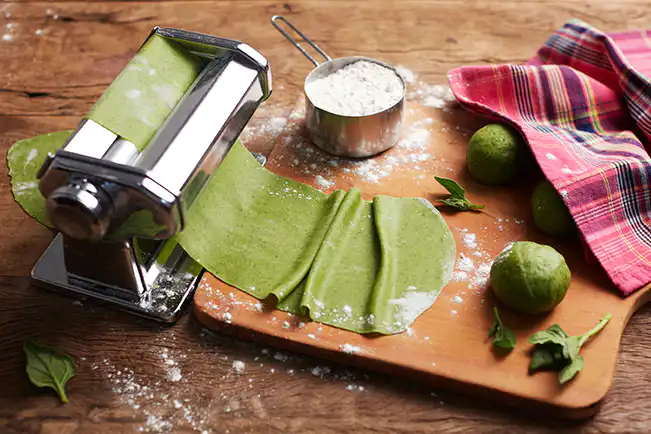
Roll out one piece of dough at a time. Lightly dust the roller and each dough piece with flour; begin with the widest setting on the roller (largest gap), feed the dough through the roller, fold it in half, and repeat this about six times until the dough becomes very soft and starts to take on a rectangular shape matching the roller’s width. Then, begin adjusting the dough thickness by gradually reducing the roller gap to the next level, dusting the dough with flour, and passing it through the roller twice. Continue this process until reaching level 6, achieving a dough thickness of approximately 1mm. Finally, run the flattened dough strip through the roller cutter or cut it into the desired shapes such as fettucine, maltagliati, or tagliatelle.
- Dust the bench (or a pillow) with flour and lay the cut and shaped dough on it. Cover with a kitchen towel to prevent the dough from drying out.
- To prepare the dough, bring approximately 5 liters of water to a boil in a large pot over high heat. Once boiling, add 2 tablespoons of salt and then the dough. Stir occasionally until it reaches an al dente texture—note that cooking time may differ depending on the dough’s thickness and shape.
- Coat the noodles lightly and serve them with your chosen sauce.
Did you receive MASSA?
The mass wrapped in the film can be kept in the refrigerator for a maximum of 2 days.