
FOR THE POLVILITY BISCUIT FAROFA
Components
- 50 grams of strawberry cookies (14 pieces)
- 1/4 cup of roasted chestnuts without salt
- 1 tablespoon of butter
- season with salt as desired
Setup phase
- Using your hands, crumble the cookies until they form a powder. Slice the chestnut thinly.
- Place a non-stick frying pan with butter over medium heat. Once the butter has melted, add the chestnut, season with a pinch of salt, and stir for 1 minute to release the aroma. Then, add the biscuit and gently mix for another minute to toast it lightly, being careful not to break the cookie too much. Transfer to a bowl and set aside.
NOTE: The lighthouse can be prepared up to 5 days in advance and kept in an airtight container at room temperature.
FOR THE RISOTTO
Components
- 2 tea cups of Arborio rice for risotto
- Five cabbage leaves
- 1 stalk of leek
- One onion
- Two-thirds of a cup (tea) of white wine
- 1.5 liters of homemade vegetable stock
- 3 tablespoons of extra virgin olive oil
- 2 tablespoons of butter
- 3/4 cup of finely shredded Parmesan cheese
- lemon peel pieces
- Add salt and ground pepper as desired.
- Beet and parsley sprouts for serving
Setup mode
- Clean the cabbage. Grasp the stalk with your hands and tear the leaves into 5 cm pieces to make blending easier. Arrange the stalks neatly.
- Slice the leek into rings; place them in a sieve and rinse under running water — store the leaves in the fridge (or freezer) for making broths. Peel and dice the onion.
- Place a medium-sized pan filled with water on high heat and prepare a bowl with ice water. Once the water reaches a boil, add 2 teaspoons of salt and submerge the torn cabbage leaves. Keep the cabbage submerged for a few seconds, then use a slotted spoon to move it to the ice water bowl—this process, known as blanching, enhances the cabbage’s vibrant color.
- Place the cabbage leaves in the blender, pour in 1/2 cup of water, and blend until finely shredded — this “kale tart” will give the risotto a vibrant green color. Enjoy!
- Use the same pot you used to blanch the cabbage (draining the water) to heat the vegetable broth over high heat. Once it reaches a boil, reduce the heat and keep the broth warm while you prepare the risotto.
- Place a large pot over medium heat. Add 3 tablespoons of olive oil, then include the cabbage stems, onion, and chopped leek. Season with a pinch of salt and cook for approximately 5 minutes, until softened.
- Incorporate the rice and cook for 2 minutes, ensuring the beans are thoroughly coated with the olive oil. Season with salt and pepper—keep in mind that homemade broth doesn’t require additional salt!
- Sauté with wine and stir thoroughly until the liquid evaporates. Add two ladles of broth and continue mixing. Stir occasionally until the liquid is absorbed. Season with salt and pepper and continue the process, adding broth one ladle at a time and stirring, until the risotto reaches the desired texture — the grains should be cooked yet slightly firm in the center (al dente), which takes around 15 minutes. In the meantime, get the pork belly ready.
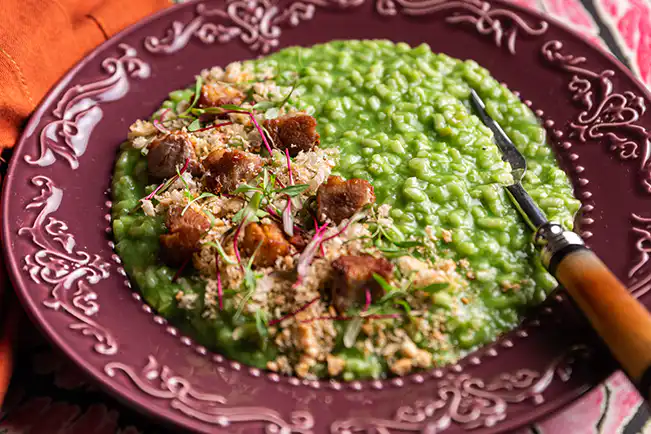
- Note: When adding the final portion of broth, include the “couve tart,” stir thoroughly, and then turn off the heat. Avoid letting the risotto dry out completely; it should remain quite moist. Incorporate butter, parmesan, and lemon zest. Serve immediately alongside the pork belly, strawberry biscuit head, and the beet and parsley broths.
Por supuesto, por favor proporcione el texto que desea que parafrasee.
You can make the entire refogado and partially cook the rice in advance. Then, when your friends arrive, the kitchen will be clean, and you only need to finish cooking the risotto in the pan.
Once the white wine is added, pour in half of the hot broth (750 ml) all at once and stir thoroughly. Allow it to cook without stirring until the broth has evaporated, which should take around 10 minutes. Then, spread the partially cooked rice in a thin layer on a large baking sheet to help it cool more quickly. Place it in the refrigerator until ready to finish (this step can be done the day before).
To complete the risotto: put the risotto back into the pan, pour in 1 cup of the warm broth, and stir over medium heat until heated through. Continue adding the remaining broth, ladle by ladle, until the risotto reaches the desired consistency. Finish the dish as described in step 9 of the recipe.
Please provide the text you would like me to paraphrase.
Components
- 250 g of pork belly cut in a piece (or panceta)
- 1 teaspoon of olive oil
- Add salt and ground pepper gradually to achieve the desired flavor.
Setup phase
- Remove and discard the pork belly skin (or rind). Cut the meat into 2 cm cubes and season with salt and pepper. Place a paper towel on a plate.
- Place a large frying pan over medium heat. Add the olive oil, then the pork belly, and cook until browned for about 10 minutes, stirring occasionally to ensure it cooks evenly on all sides. Transfer the pork to a plate lined with paper towels and set aside.
VEGETARIAN OPTION
For a vegetarian alternative, use grilled zucchini in place of pork belly. Slice 1 zucchini into 1.5 cm pieces and cook over medium heat for approximately 6 minutes in a non-stick skillet with 2 teaspoons of olive oil, seasoning with salt and pepper.